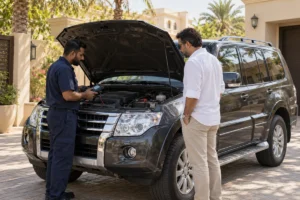


One car that will not start can delay a driver. For a Dubai business with several cars or light vans, it can also disrupt the first jobs of the day. The practical response is to identify which vehicle has a weak battery, check whether the charging system is part of the problem, and replace a battery only when the test and vehicle specification support that decision.fleet battery replacement Dubai
This guide is for businesses managing passenger cars and light commercial vans in Dubai. It explains how to plan a fleet battery check, what to record, and what to send when you request mobile help. It concerns the vehicle’s 12V starter or auxiliary battery, not an electric vehicle’s high-voltage traction battery.
Why a Dubai fleet needs a battery plan
Heat speeds up wear inside a lead-acid battery. Daily use also matters: frequent starts, short routes and electrical accessories can leave a battery with less charge than the next start needs. A van doing many short deliveries has a different duty cycle from a car driven on a longer journey each day. Battery age alone cannot tell you which vehicle will fail next. VARTA explains how short trips can prevent a starter battery from recovering the energy used to start the engine.
There is a useful Dubai example, but it should be read carefully. VARTA reported a 12-month field trial involving 60 identical Dubai taxis. In that unusually intensive test, the conventional starter batteries failed after roughly five to six months, while its comparison group using AGM batteries remained in service through the test. Those results describe that trial’s vehicles and operating pattern; they are not a lifespan forecast for every business car in Dubai or a reason to fit AGM to every vehicle.
A simple fleet battery check, vehicle by vehicle
1. Make a short vehicle list
Record each vehicle’s make, model, year and where it is parked. Add the battery’s age if you know it, whether the car has start-stop, and any recent jump starts or slow starts. For a mixed fleet, a photo of the current battery label can help identify the fitted type and rating. Only take that photo if the battery is safely accessible; the vehicle details are enough to start a conversation.
2. Put the problem vehicles first
A vehicle that cranks slowly, clicks, or needs repeated boosts deserves attention before one that starts normally. A battery warning light that stays on with the engine running can point to a charging-system fault and needs more than a routine battery swap. If a battery case is swollen, cracked or leaking, leave it alone and ask a technician to assess it.
3. Test before ordering replacements
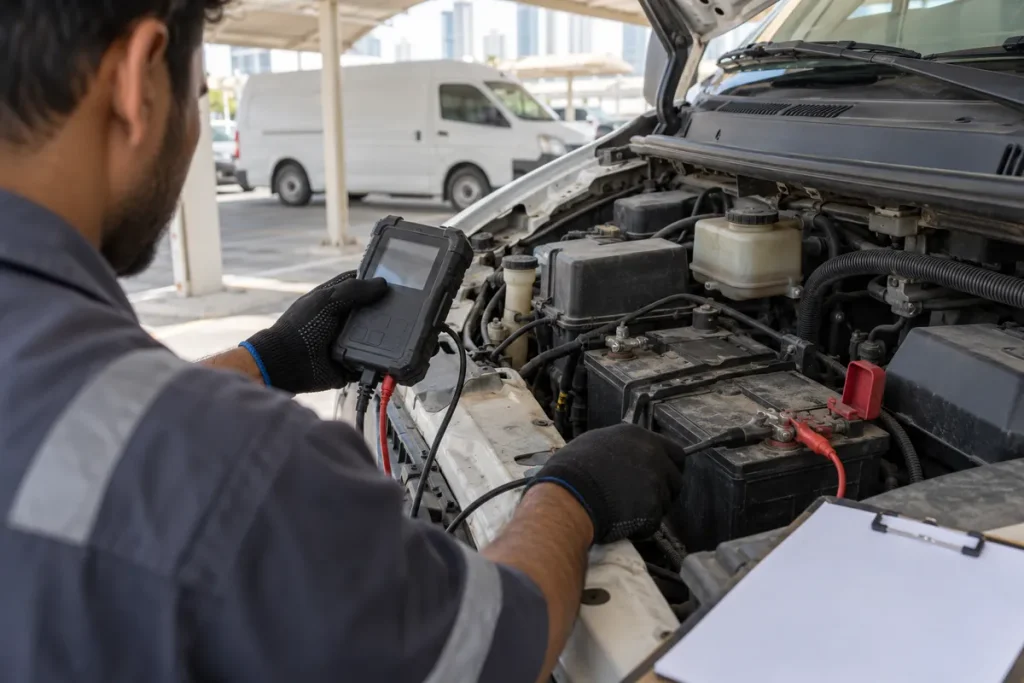
A low charge reading does not by itself prove the battery has failed. The battery’s ability to start the vehicle, its condition, the connections and relevant charging-system indicators all matter. VARTA’s testing guidance distinguishes state of charge from state of health, especially for AGM and EFB batteries. If a vehicle repeatedly goes flat while parked even after its battery and charging system check out, it may need a separate electrical-drain diagnosis.
4. Choose the correct next action
| What you notice | What to ask for |
|---|---|
| First no-start after the car sat unused | Jump-start help and a battery check; the battery may simply need charging. |
| Slow cranking or repeated jump starts | Battery and charging-system checks, followed by a replacement recommendation if the battery fails testing. |
| Battery warning light while driving | Prompt charging-system assessment; do not assume a new battery will solve it. |
| New battery goes flat again | Check charging, connections and possible parked-current draw before buying another battery. |
For a single vehicle that needs a boost, see the Dubai jump-start service. If testing shows the battery has failed, the mobile car battery replacement service in Dubai explains how an on-site fitting is arranged.
5. Match the replacement to each vehicle
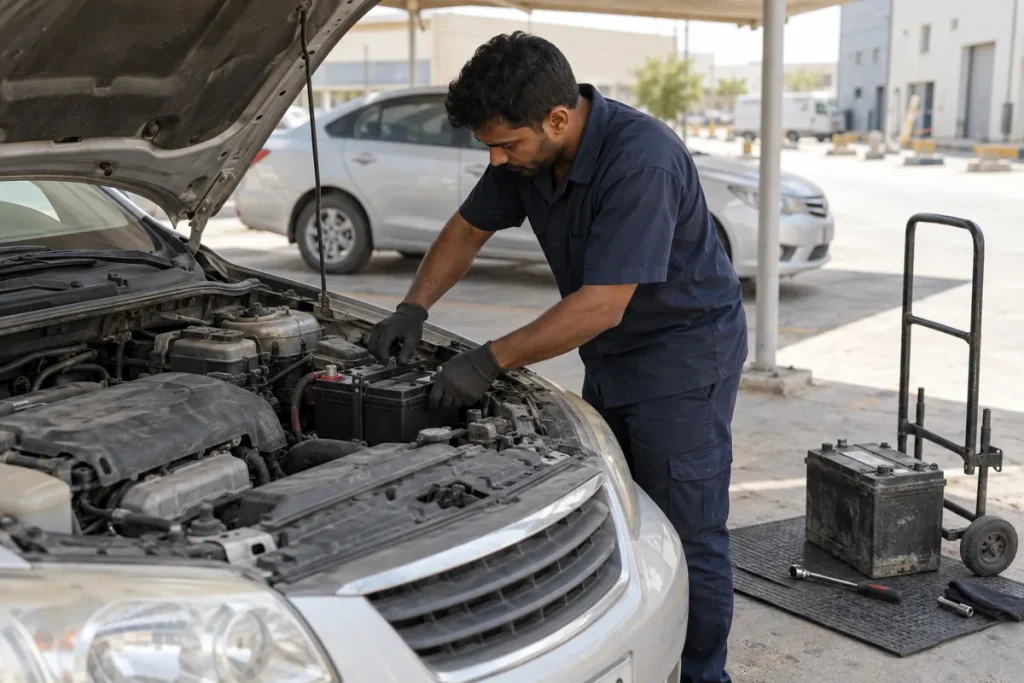
Do not order one battery type for every vehicle just because several cars share a parking yard. Size, terminal layout, capacity and battery technology vary by model. Some start-stop vehicles require AGM or EFB, and certain vehicles require a registration step after replacement. Confirm the requirement for each make, model and year. For the technology difference, read the AGM versus normal battery guide.
Plan the on-site visit around your operations
Tell the service team whether the vehicles are together at one Dubai yard or parked at several offices, sites or driver locations. Include the number of vehicles needing immediate attention, their locations, and a time when someone can provide access and keys. A basement level, security gate or loading-bay restriction is worth mentioning before dispatch.
Ask the team to confirm which checks and fittings can be arranged for your specific group of vehicles, when a technician is available, and how the price will be quoted. A fleet request may need a different plan from a single roadside call. There is no reason to buy replacement batteries for every vehicle before the problem vehicles have been assessed.
What to send for a fleet battery quote in Dubai
- Your business location in Dubai and whether all vehicles are at the same site.
- How many passenger cars or light vans need help now, plus any others you want checked.
- Each affected vehicle’s make, model and year.
- The symptom: slow crank, clicking, no start, repeated jump start or warning light.
- Any access instructions and the person who can meet a technician.
Need help with business vehicles? Send those details on WhatsApp or call +971 58 242 4859. Battery Boost Dubai can confirm the service scope, available battery options, fitted price and estimated arrival before dispatch. Ask specifically about multiple vehicles if that is what you need.
fleet battery replacement Dubai questions
Can several fleet cars be checked at one Dubai location?
Send the vehicle count, models and site address. The team can confirm what can be arranged in one visit and whether a separate plan is needed for the rest.
Should we replace every battery at the same age?
No. Age is a useful prompt to check a battery, but condition, charge, symptoms and vehicle use determine the next step. Test the vehicles that show problems, then decide individually.
Will a jump start fix a fleet vehicle that will not start?
It may get the vehicle running, but it does not identify why the battery went flat or whether it can hold charge. Repeated no-starts call for testing before that vehicle goes back into a critical shift.
Does this advice cover trucks and electric vehicle traction batteries?
This guide covers 12V batteries in passenger cars and light vans. Tell the team the exact vehicle type for trucks, buses or electric vehicles so they can confirm whether the requested work is within their service scope.